Pages

Related Posts with Thumbnails
Showing posts with label Stolen Items. Show all posts

Wednesday, April 9, 2008

Wired: Macs in Damascus, Hasan the local 'Mac Guru'

Wired.com's story, The Mac Guru of Damascus in the Case of the Missing Laptops, is about Eric Umansky's experience losing his MacBook and his fiancée's MBP in Syria to a break in.
Before my fiancée and I headed to Syria to study Arabic, we often heard there was one advantage to living in a police state: almost no crime. So it came as a surprise when Sara and I returned to our Damascus apartment one night after a dinner party to find splintered wood in the hallway — wood that had once been part of our front door. I made a beeline for the living room to check on our most valuable possessions: my MacBook and Sara's MacBook Pro. Both gone.

Eric, the author who wrote his story on his recovered laptop, is a contributing writer for various publications and a columnist for Slate. He wrote that it wasn't the authorities who eventually led him to the thief almost two days after the crime, but a contact to an unlikely fellow: a local Mac technician.

A friend had put us in touch with Bassel Al Hassan, apparently the one guy in Damascus who services Macs. A few days later we shared a meal with Hassan, a soft-spoken man in his mid-thirties. "Yours were the seventh and eighth stolen Macs I've recovered," he said.

Eric said Al Hasan called up computer shops in town not telling the shop owners about the stolen Macs. When one of the shop owners confirmed having two units in his possession which he paid $200 for, Hasan informed the owner that the computers were hot items. The shop owner then met up with Eric and his fiancée at a street corner in our neighborhood.

Meanwhile, Eric wrote that all Bassel Al Hasan wanted in exchange for helping them recover the Macs was permission to 'friend' Eric on Facebook.>/p> Whole story here.

Monday, February 25, 2008

Shoujiki

Receiving some guests recently, particularly the parents of an American volunteer in town for his wedding, and his counterpart from the Ifugao province, we touched upon the issue of keeping our things safe from thieves even in a seemingly safe place like mid-scale Ortigas and its upscale cafés.

Our volunteer-friend narrated how he once dropped his cell phone in a tricycle in Kiangan, Ifugao, only to be returned to him after it was found by young locals who called the last number they saw was dialed. Apparently, the youth who found his cell phone called up our friend's last dialed number and told the answering party that they were looking for the owner of the cell phone. Our friend was informed about it a few days later and was just too happy to take the 30-minute rough ride down to Kiangan to retrieve his cell and treated the finders to a round of drinks. Our friend knows that if that happened in a highly urbanized area besides Metro Manila, that retrieval was highly improbable.

I came upon this New York Times article and recalled the discussion we had at the Ortigas café. It is about the Japanese Law on Lost Goods or the ''Notes on the Law on Lost Property'', a code established in 718 (that's right, before the unification of Japan). It states, in part:

Back then, lost goods, animals and, mysteriously, servants had to be handed over to a government official within five days of being found. After a year, the government took over the belongings, though the owner could still reclaim them. The code stipulated that people had no right to keep lumber found adrift in a flood.

Shoujiki, or "honesty" in Japanese, pertains to the ideals of being truthful and sincere. It is one of many ways "honesty" in Japanese is carried out or lived by. It does not even have to be a biblical tenet, just a basic human principle of trust and respect and fairness, even in today's world of the disposable and instant.

In modern Japan, what used to be the loss and retrieval of livestock, vegetables and lumber have given way to gadgets, toys and other personal ephemera.

The item with the highest return rate -- 75 percent -- is the cellphone, which has flooded the center in the last three years. Owners typically call their own phones, or the center traces the owners through their subscription and sends a notification postcard.

"Umbrellas, the item most commonly lost — and the least reclaimed — 
at the Lost and Found Center in Tokyo." (Ko Sasaki for The New York Times)

We've often wondered how else besides being precise, pragmatic and respectful, the Japanese are successful at whatever undertaking they attempt or do. I would surmise that adhering to and respecting tradition and their own version of the concept of kapwa-tao (sharing and kindness), albeit basic as it sounds, are ingredients to keeping their public safe and their integrity intact.

''I feel uncomfortable holding another person's money,'' Mr. Hirahaya (a photographer who found and returned cash) said ''I think many Japanese people feel the same way and hand over something they find. I think among Japanese there's still a sense of community since ancient times.

Read the full New York Times article Never Lost, but Found Daily: Japanese Honesty by Norimiysu Onishi (Published: January 8, 2004) and see what lessons we can get from practicing something as simple and basic as honesty.


‣ Calligraphy image courtesy of www.orientaloutpost.com ‣ Lost and found center image courtesy of the New York Times.

Here's the LIST of stolen items (updated).

Sunday, December 30, 2007

When yours is stolen...

The first thing to do, as I gather from various forums and sources, is to report the incident to the police. This way, the incident becomes official and all relevant information related to the lost items are noted. This same document will be very helpful in determining ownership should the opportunity for recovery comes up.

Make copies of the official document and give them out to all Apple Authorized Service Centers. It helps to scour areas where laptop pawnshops proliferate and request them to either receive a copy of your document (at least) or post it in a public and visible area of their shop.

It also pays to post messages in trade sites known to buy and sell technology stuff like ebay.ph, auctions.ph and special-interest forums and groups (like YahooGroups or GoogleGroups).

Lastly, use the power of email. It's still a wonder that laptop theft is under-reported in Manila (and elsewhere) in spite of the fact that laptops aren't just expensive, they make our lives somewhat easier, hold valuable information and make, or break, our means of livelihood.

Here's the LIST of stolen items (updated).

Tuesday, August 14, 2007

A Universal Message

Or why it only takes a few seconds to reconsider our safety at all times... Thanks to deepblue of philMUG for the link.

Sunday, July 15, 2007

One for the books

BREAK-INS AND BURGLARY are not the most exciting experience, but these can certainly leave the most impression on the victims. Sometimes, the effect of media exposure on crimes may leave a numbing effect on the public unless, of course, it happens to our neighbors or us.
"Just a couple of minutes ago, we were able to catch in the act the person we suspect have stolen several laptops, and cellphones in the building.

We were able to identify him thru an earlier security cam video, and when he entered the office, those of us who recognized him went to all the exits to block him off. He tried to muscle his way out but we got him pinned down to the floor. He was caught red-handed with a stolen cellphone in his pocket.

A word of warning though,

a. These guys don't work alone. One of his cohorts would pretend to pin him down, but will try to slyly slip the evidence away. When somebody shouted the cellphone is in the fire exit stairways, he let go of the arm, and went ahead to check the fire exit. He never went back. He is still on the loose.

b. They target offices or cubicles that are blocked off from general view (like a cubicle that's right beside a building post, or a wall).

c. And if you think they won't come back right after a theft, you'd be surprised that they actually do.

d. Don't believe any crap coming out of their mouths."
This almost blow-by-blow account was posted online in one of the forums I am a member of. The incident, as with the above post, was dated July 2, 2007. The extraordinary value of this account is that the witness &mdash a forum member himself &mdash along with his office mates, took action, subdued the suspects and did their civil duty of reporting the crime to the authorities almost instantaneously, all the while being able to sound off other members of the forum by posting online (talk about some kind of citizen journalism). Fortunately, there were no casualties reported.

Well, the suspects' accomplices managed to flee (there were allegedly four of them), the subdued suspect was booked and the victims filed a case. Our member-reporter (let's call him 'CJ', aka citizen-journalist) also managed to secure clearance to post the pictures of the incident.

Does it end there? I believe it does not, as it only starts where we think it ends. We start by being vigilant and alert. Then we become cautious, probably spending on some security stuff for our peace of mind. Also, we start making decisions, like, do we actually react according to what is expected of us (e.g. call for help and alert others around us) or not?

Someone replied to the thread above, which I think is basic and very, very timely (and also echoes my sentiments):
"Though not totally theft-proof, it still adds a level of security especially when you're always alert and vigilant. Professional thieves have good instincts in detecting "qualified" victims."
Over and above it all, we do have a responsibility to stop a crime when we see one. Of course with this responsibility comes the risk, but if the criminals are allowed to get away with it once, what will stop them from doing the same thing all over again?
Photos courtesy of "CJ". Thanks for sharing.

Sunday, June 17, 2007

(In)Tolerance


Manila, Philippines.

IT IS TRUE: EVEN NOONTIME GAME SHOWS have been giving away notebook PC computers to contestants by asking (almost) very elementary questions. And, why not? Haven't computers leveled the field for the haves and will-haves for decades already? Everyone deserves a digital life.

Computers of all sizes have created a virtual life of freedom. On the other hand, it may also have encouraged a different kind of freedom for other members of society, that is, the freedom to take someone else's property. Well, it is not as if stealing is a recent phenomenon. From petty theft to big-time plunder, they do come in all shapes and sizes.

With the dropping of prices of notebook computers happening at every mall and distributors' shops, not to mention the boost in purchasing power of the average consumers, come the unpleasant realization that some of our movements may have to be curtailed.

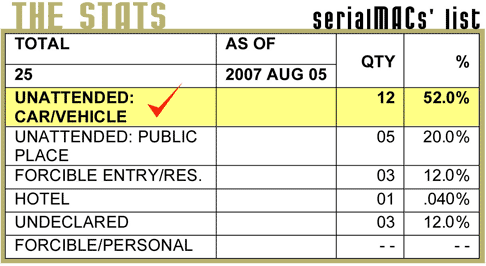
It is alarming that the spate of laptop theft happening around the Metro have occurred quite regularly, mostly in public spaces as guarded parking areas and popular cafés. Coincidentally — though this is not to condemn legitimate businesses — so have the sprouting of laptop pawnshops (some with signage screaming: LAPTOP PAWNSHOP).

It seems that our low-tech elements have gone hi-tech. These low-lifes have graduated from snatching cellphones to stealing laptops for obvious reasons (in the same token, so have pawnshops and other shady trading posts). It is not identity theft or credit card fraudulence that makes it to the top of the list of technology-related crimes in this country, but low-tech means like smashing a car window or unlocking a car door with wires to steal notebook computers and other gadgets, that do (the thieves do not seem to care as much for the cars, leaving them behind). Apparently, surveillance cameras won’t help either: if not smashed or vandalized, maybe they are set-up only as props.

A laptop is an investment, whether bought brand new or second-hand. It is used by many law-abiding, tax-paying citizens to make an honest living. On the side, it may function as a toy, a journal of personal milestones, a communication device, but it is primarily a tool for work by many. What right have you, varmint, to take that away?

So, here it is, a lonely site that may serve like a roll call or a memorial list of the serial numbers of stolen Apple computers and gadgets from Manila and elsewhere, culled from popular forums and posted notices on the internet. (I’m pretty sure there as are many lost PC notebooks out there.)

Since Apple Inc. itself does not have a database of stolen items in its site, and Manila without an official Apple office to receive complaints (except for very reliable certified service centers) this site aims to make public the serial numbers of items for fair public warning. Let's just say the we have developed intolerance for taking someone's life, because in many cases that's just what it is.

Is yours on the list?